
A Frustrating Problem That's More Common Than You Think
You press the button on your garage door remote, the door starts its descent, and then — right before it reaches the floor — it stops and reverses back up. You try again. Same thing. Maybe it works on the third attempt, or maybe it doesn't work at all.
If you're dealing with this issue at your Denver home, you're not alone. A garage door that reverses before closing completely is one of the most common service calls we get at Denver Garage Door Pro. The good news is that the cause is usually identifiable, and in many cases, the fix is straightforward.
Let's walk through the most likely reasons your garage door won't stay closed and what you can do about each one.
The Safety Sensors Are Misaligned or Blocked
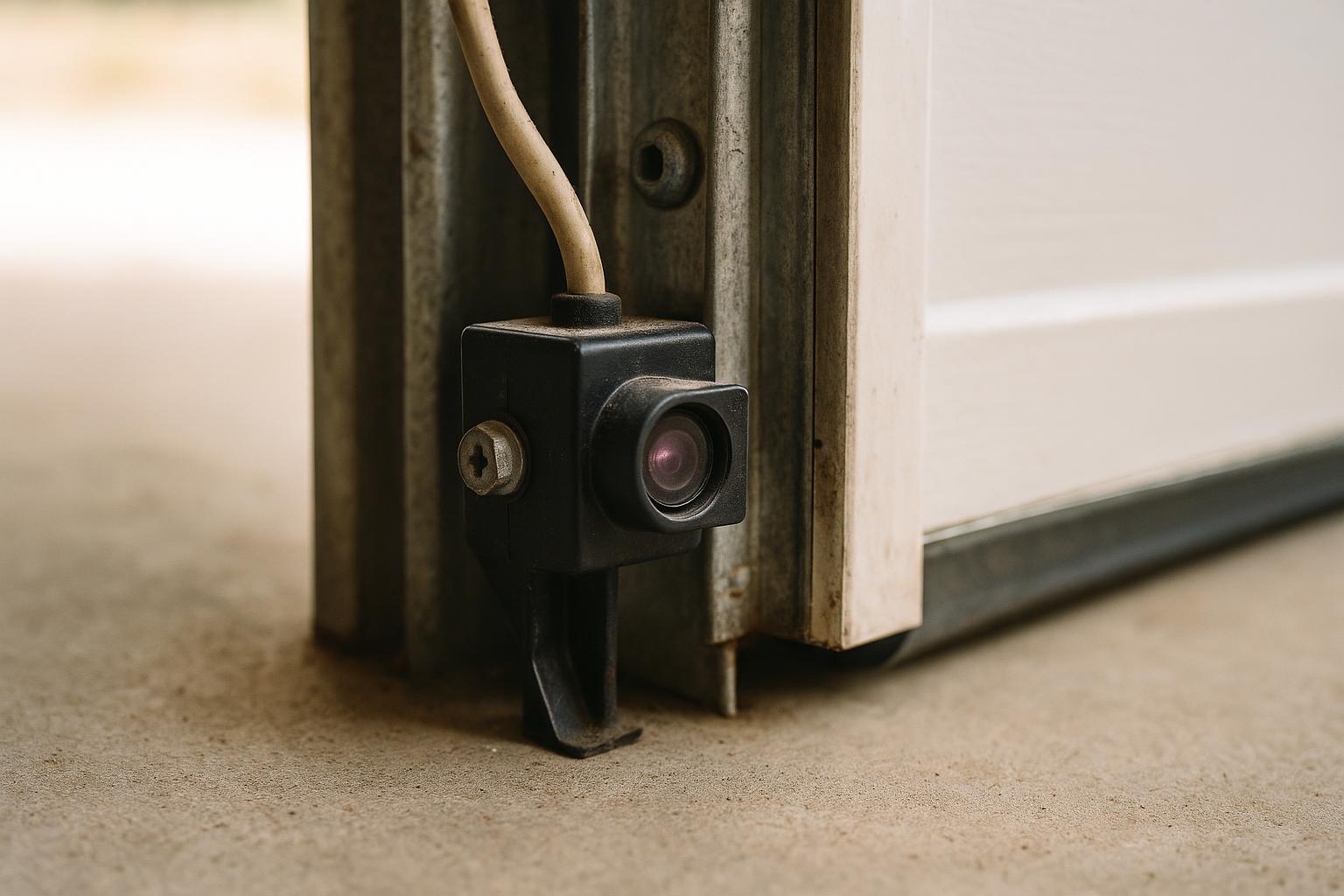
This is the number one cause of a garage door reversing before it reaches the ground. Every garage door opener manufactured after 1993 is required to have photo-eye safety sensors installed near the bottom of the door tracks, about six inches off the ground. These sensors send an invisible beam across the opening. If anything breaks that beam — a bike, a trash can, a leaf, or even a spiderweb — the door interprets it as an obstruction and reverses.
Here's what to check:
- Look for obstructions. Walk along the bottom of the door opening and make sure nothing is blocking the sensor path.
- Clean the sensor lenses. Dust, dirt, and cobwebs can accumulate on the small lenses. Wipe them gently with a soft cloth.
- Check the alignment. Each sensor has a small LED light. If one is blinking instead of glowing steadily, it's likely out of alignment. Gently adjust the sensor bracket until both lights are solid.
- Inspect the wiring. Over time, the thin wires running from the sensors to the opener can get damaged, especially if they've been nicked by a lawn trimmer or pinched against the wall.
For many homeowners in Denver and the surrounding Lake Norman area, a simple sensor cleaning solves the problem entirely.
The Close-Limit Switch Needs Adjustment
Your garage door opener has a setting called the close-limit switch (sometimes called the travel limit). This tells the opener how far the door needs to travel before it's considered fully closed. If this setting is off — even by a small amount — the opener may think the door has hit something when it's actually just reaching the floor, causing it to reverse.
On most openers, the travel limit is adjusted using a small screw or dial on the back or side of the motor unit. Turning it in small increments can solve the problem. However, if you're not comfortable working with your opener's settings, this is a quick fix for a technician.
The Tracks Are Damaged or Misaligned
Your garage door rides along metal tracks on both sides. If those tracks are bent, dented, or have shifted out of alignment, the door can bind or encounter resistance as it moves. When the opener senses that extra resistance, it treats it like an obstruction and reverses the door as a safety precaution.
Run your eye along the tracks from one end to the other. They should be straight, parallel, and free of dents. You can also look for gaps between the rollers and the track, which indicate misalignment. Minor bends can sometimes be corrected with careful adjustment, but significant track damage usually requires professional repair or replacement.
Worn or Broken Rollers Are Creating Resistance
Garage door rollers — the small wheels that guide the door along the tracks — wear out over time. When they crack, chip, or seize up, they create friction that the opener interprets as resistance. Nylon rollers tend to last longer and operate more quietly than steel ones, but all rollers have a finite lifespan.
If your door sounds louder than usual or seems to hesitate at certain points during travel, worn rollers could be contributing to the reversing issue. Replacing rollers is a relatively affordable maintenance item that can make a big difference in how smoothly your door operates.
The Springs Are Failing
Your garage door springs do the heavy lifting — literally. They counterbalance the weight of the door so the opener doesn't have to work as hard. When springs weaken or begin to break, the door becomes much heavier for the opener to manage. The opener may struggle on the way down and reverse because it detects too much resistance.
Signs of failing springs include:
- The door feels unusually heavy when you lift it manually
- The door slams down quickly when closing
- You hear loud creaking or popping noises during operation
- The door opens unevenly, with one side higher than the other
Important safety note: Garage door springs are under extreme tension and can cause serious injury if handled improperly. Spring repair or replacement should always be done by an experienced professional. If you suspect your springs are the issue, give us a call rather than attempting a DIY fix.
The Opener Force Settings Need Calibration
In addition to travel limits, your garage door opener has force settings that control how much power it uses to open and close the door. If the downward force is set too low, the opener may not push the door all the way down and will reverse prematurely.
Like the travel limit, force settings are typically adjusted via small dials or screws on the opener unit. Increase the down force in small increments and test the door after each adjustment. Be careful not to set it too high, though — the force setting exists as a safety feature to prevent the door from crushing objects or people beneath it.
When to Call a Professional
Some of the fixes above — cleaning sensors, removing obstructions, minor adjustments — are well within the ability of most homeowners. But if you've tried the basics and your door is still reversing, or if the problem involves springs, tracks, or opener components you're not familiar with, it's time to bring in a professional.
At Denver Garage Door Pro, we troubleshoot reversing doors regularly for customers throughout Denver, Mooresville, Huntersville, Cornelius, Davidson, and Lincolnton. In most cases, we can diagnose and fix the issue in a single visit.
Don't Ignore a Door That Won't Close
A garage door that won't stay closed isn't just an inconvenience — it's a security risk. Your garage likely contains tools, vehicles, and direct access to your home. Leaving it open overnight because the door keeps bouncing back up is not a situation anyone wants to deal with, especially during the unpredictable weather we get here in the Denver area.
If your garage door is reversing and you can't figure out why, don't hesitate to reach out. We'll get it diagnosed, get it fixed, and get you back to pressing that button with confidence.